
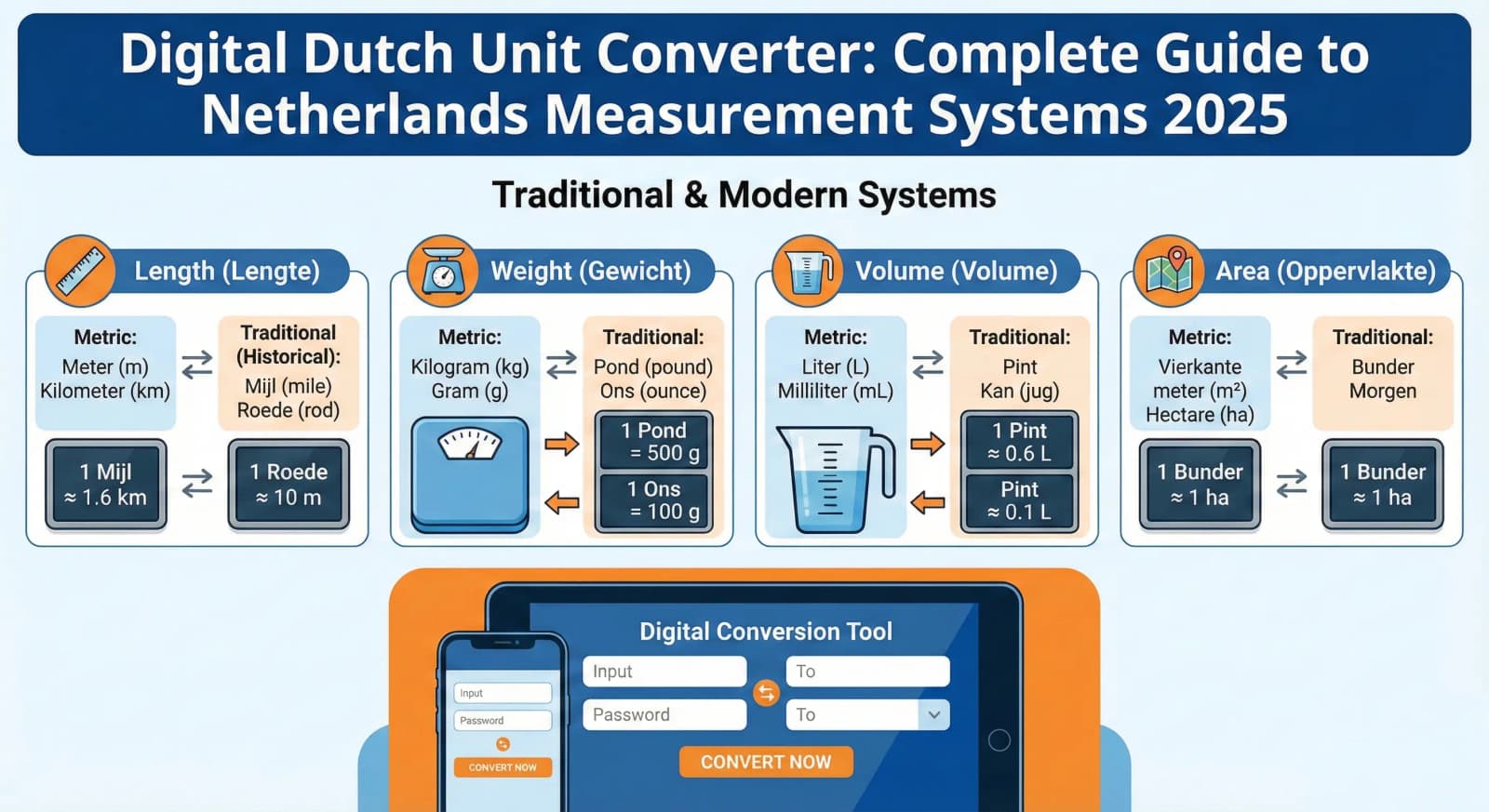
What Is a Digital Dutch Unit Converter and Why Does It Matter?
Quick Answer: A digital Dutch unit converter is an online tool that transforms traditional Netherlands measurement units (voet, pond, morgen, el) into modern metric or imperial units, essential for historians, genealogists, cooks using old recipes, and researchers working with Dutch historical documents.
Imagine discovering your great-grandmother's handwritten recipe from 1850s Amsterdam, calling for "2 pond flour" and "1 kop milk." Without understanding Dutch traditional units, you'd be lost. Or perhaps you're researching land records from the 17th century Netherlands, encountering measurements in "morgen" and "roede"—units that haven't been officially used since the 19th century. This is where a digital Dutch unit converter becomes invaluable.
The Netherlands officially adopted the metric system in 1816, but traditional Dutch measurement units persisted in daily use, legal documents, and cultural practices well into the late 1800s. Today, while modern Dutch society uses metric units exclusively, historians, genealogists, researchers, and cultural preservationists regularly encounter these traditional measurements in archives, old cookbooks, land deeds, and historical texts. Understanding these conversions is similar to mastering other historical measurement systems, as explored in our guide to the historical evolution of measurement systems.
Real Impact: In 2023, a Dutch genealogy researcher spent weeks manually converting hundreds of land measurements from 18th-century property records before discovering digital conversion tools. What took weeks of calculations and cross-referencing multiple historical sources now takes minutes with accurate digital converters. This efficiency isn't just about speed—it's about preserving historical accuracy and making Dutch cultural heritage accessible to modern researchers.
Digital Dutch unit converters bridge the gap between historical Netherlands and the modern world, enabling accurate interpretation of documents that would otherwise require extensive research in specialized libraries or consultation with historical measurement experts. Whether you're converting a 200-year-old recipe, analyzing property records, or studying Dutch trade history, understanding these conversions unlocks a deeper appreciation of Netherlands culture and history. For those working with other measurement systems, our comprehensive guide to common systems of units provides essential context for understanding measurement diversity worldwide.
Why Dutch Unit Conversion Challenges Researchers and Historians
Converting Dutch traditional units presents unique challenges that go beyond simple mathematics. Unlike modern standardized systems, historical Dutch measurements varied by city, region, and time period, creating a complex web of conversions that can frustrate even experienced researchers.
Regional Variations: Before metric standardization, Amsterdam, Rotterdam, Haarlem, and other Dutch cities each maintained their own measurement standards. The Amsterdam voet (foot) measured 0.283 meters, while Rotterdam's voet was 0.296 meters—a difference that compounds significantly over larger measurements. This regional variation means researchers must identify not just the unit type, but also the city or region of origin. Similar challenges exist with other measurement systems, as detailed in our comparison of metric vs imperial systems.
Time Period Complexity: Dutch units evolved over centuries. A "pond" from the 1600s might differ slightly from a "pond" used in 1800, even within the same city. Legal documents, trade records, and personal correspondence from different eras require understanding these temporal variations to ensure conversion accuracy.
Hidden Costs of Manual Conversion: Researchers manually converting Dutch units face significant time investment—hours spent cross-referencing historical measurement tables, verifying city standards, and double-checking calculations. One genealogy project involving 500 historical land records required over 40 hours of manual conversion work before digital tools became available. The risk of calculation errors increases with manual methods, potentially leading to incorrect historical interpretations or legal complications.
Accessibility Barriers: Without digital conversion tools, accessing accurate Dutch unit conversions requires specialized knowledge, access to historical measurement references, or consultation with experts. This creates barriers for amateur historians, family researchers, and students who want to explore Dutch historical documents but lack professional resources. Modern online unit converters save significant time and effort by automating these complex calculations.
How Digital Dutch Unit Converters Solve Historical Measurement Challenges
Modern digital Dutch unit converters address these challenges through three key approaches: comprehensive unit databases, city-specific conversion standards, and instant calculation accuracy. These tools transform complex historical research into accessible, accurate conversions.
Priority 1: Comprehensive Unit Coverage - The best digital converters include all major Dutch traditional units across categories: length (voet, duim, el, roede), weight (pond, ons, lood), area (morgen, bunder, roede), and volume (kop, kan, vat). This comprehensive coverage eliminates the need to consult multiple reference sources.
Priority 2: City-Specific Standards - Advanced converters offer city-specific conversion options (Amsterdam, Rotterdam, Haarlem, etc.), accounting for regional variations that existed before metric standardization. This feature is crucial for accurate historical research where city origin matters.
Priority 3: Historical Context Integration - The most valuable converters provide historical context alongside conversions, explaining when units were used, how they evolved, and their cultural significance. This educational component helps researchers understand not just the numbers, but the historical meaning behind measurements. For step-by-step conversion guidance, our step-by-step unit conversion guide offers practical techniques applicable to Dutch units.
Decision Flow: When encountering a Dutch unit in historical documents, first identify the unit type (length, weight, area, volume), then determine the likely city or region of origin based on document context, select the appropriate converter with city-specific options, and finally verify the conversion using historical references when accuracy is critical.
Understanding Traditional Dutch Measurement Units
Traditional Dutch measurement units reflect centuries of Netherlands history, trade, and daily life. Understanding these units requires exploring their origins, variations, and relationships to modern measurements. These units represent a fascinating chapter in measurement history, similar to the evolution explored in our history of metric vs imperial systems.
Length Units (Lengte-eenheden)
| Dutch Unit | Amsterdam Standard | Modern Metric | Historical Use |
|---|---|---|---|
| Voet (Foot) | 1 Amsterdam voet | 0.283 meters | Common length measurement |
| Duim (Thumb/Inch) | 1/12 voet | 2.36 cm | Small measurements |
| El (Ell) | 2.5 voet | 0.69 meters | Cloth and fabric |
| Roede (Rod) | 12 voet | 3.4 meters | Land measurement |
Weight Units (Gewichtseenheden)
| Dutch Unit | Amsterdam Standard | Modern Metric | Common Use |
|---|---|---|---|
| Pond (Pound) | 1 Amsterdam pond | 0.494 kg | General weight |
| Ons (Ounce) | 1/16 pond | 31.25 grams | Small weights |
| Lood (Lead) | 1/32 ons | 0.977 grams | Precise weights |
Area Units (Oppervlakte-eenheden)
| Dutch Unit | Definition | Modern Metric | Historical Significance |
|---|---|---|---|
| Morgen (Morning) | Land plowed in morning | 0.85 hectares (2.1 acres) | Agricultural land |
| Bunder | Standard area unit | 1 hectare | Land measurement |
| Roede (Square Rod) | 12 voet × 12 voet | 100 square meters | Small plots |
Volume Units (Inhoudseenheden)
| Dutch Unit | Amsterdam Standard | Modern Metric | Common Use |
|---|---|---|---|
| Kop (Cup) | 1 kop | 0.25 liters | Cooking, liquids |
| Kan (Jug) | 4 kop | 1 liter | Larger volumes |
| Vat (Barrel) | Varies | ~100-200 liters | Trade, storage |
How to Use Digital Dutch Unit Converters: Step-by-Step Guide
Using digital Dutch unit converters effectively requires understanding the conversion process, identifying unit types, and selecting appropriate standards. Follow these steps for accurate conversions.
Step 1: Identify the Unit Type
Examine your historical document or source to determine whether you're working with length, weight, area, or volume units. Common indicators include context clues (land records suggest area, recipes suggest weight/volume) and unit names (voet/el = length, pond/ons = weight, morgen = area, kop/kan = volume).
Pro Tip: If uncertain, look for surrounding context. A "morgen" mentioned with "land" or "field" indicates area measurement, while "pond" with food items suggests weight.
Step 2: Determine City or Regional Standard
Identify the city or region where your document originated. Check document headers, signatures, or historical context for location clues. Amsterdam, Rotterdam, Haarlem, and other cities each maintained distinct measurement standards before metric adoption.
Pro Tip: If city origin is unknown, use Amsterdam standards as the most common reference, but note potential variations in your research documentation.
Step 3: Select Appropriate Digital Converter
Choose a digital converter that supports Dutch traditional units and offers city-specific options. Look for converters with comprehensive unit databases, historical context, and clear conversion results. UnitConvertNow provides extensive Dutch unit conversion capabilities.
Pro Tip: Verify converter accuracy by testing known conversions before using for critical research.
Step 4: Enter Value and Select Units
Input the historical Dutch unit value into the converter, select the source unit (e.g., "Amsterdam voet"), choose the target unit (e.g., "meters"), and review the conversion result. Most digital converters provide instant calculations with multiple decimal precision.
Pro Tip: Convert to metric units first, then to imperial if needed, to maintain accuracy through the conversion chain.
Step 5: Verify and Document
For critical research, verify conversions using multiple sources or historical reference tables. Document your conversion method, source standards used, and any assumptions made (such as city origin) for future reference and research transparency.
Pro Tip: Keep a conversion log noting original values, converted values, standards used, and source documents for research reproducibility.
Practical Applications of Dutch Unit Conversion
Digital Dutch unit converters serve diverse practical applications across historical research, genealogy, cooking, and cultural preservation. Understanding these use cases helps researchers maximize converter value.
Historical Research and Genealogy
Genealogists and historians regularly encounter Dutch units in property records, wills, trade documents, and personal correspondence. Converting these measurements enables accurate understanding of historical contexts—whether determining property sizes from 18th-century land deeds or interpreting trade volumes from merchant records. Accurate conversions are crucial, as highlighted in our article on why accurate unit conversions matter across all fields.
Example: A 1750 property deed listing "3 morgen land" converts to approximately 2.55 hectares (6.3 acres), providing modern context for understanding historical landholdings and agricultural capacity.
Cooking and Recipe Conversion
Historical Dutch cookbooks and family recipes often use traditional units. Converting "2 pond flour" (0.988 kg) or "1 kop milk" (0.25 liters) enables modern cooks to recreate historical dishes accurately, preserving culinary heritage while making recipes accessible. For cooking-specific conversions, our cooking temperature conversions guide complements Dutch unit conversions for complete recipe accuracy.
Example: A 19th-century recipe calling for "4 ons butter" converts to 125 grams, allowing accurate modern recreation of traditional Dutch baked goods.
Academic and Scholarly Research
Academic researchers studying Dutch history, economics, trade, or agriculture require accurate unit conversions for data analysis, comparative studies, and publication. Digital converters enable efficient processing of large datasets containing historical measurements. Researchers working with scientific data may also benefit from our guide to unit conversion in modern science and engineering.
Example: Economic historians analyzing 17th-century Dutch trade records can convert hundreds of volume and weight measurements quickly, enabling statistical analysis of historical commerce patterns.
Cultural Preservation and Education
Museums, cultural institutions, and educational programs use Dutch unit conversions to interpret historical artifacts, create educational materials, and preserve cultural knowledge. Understanding traditional measurements helps modern audiences appreciate historical contexts and daily life in past Netherlands. For beginners, our beginners guide to using unit converters effectively provides foundational knowledge applicable to Dutch units.
Common Dutch Unit Conversion Mistakes and How to Avoid Them
Avoiding common conversion mistakes ensures research accuracy and prevents misinterpretation of historical documents. Understanding these pitfalls helps researchers use digital converters effectively.
Mistake 1: Assuming All Cities Used Identical Standards
Different Dutch cities maintained distinct measurement standards. Using Amsterdam standards for Rotterdam documents (or vice versa) introduces errors. Always identify city origin when possible, or document assumptions when origin is unknown.
Mistake 2: Confusing Dutch and English Units
Dutch "pond" (0.494 kg) differs from English pound (0.454 kg). Dutch "voet" (0.283 m) differs from English foot (0.305 m). Never assume Dutch units equal their English namesakes—always use Dutch-specific conversion factors.
Mistake 3: Ignoring Time Period Variations
Dutch units evolved over centuries. A "pond" from 1600 might differ slightly from 1800, even within the same city. For critical research, verify time period and consult historical measurement references when accuracy is essential.
Mistake 4: Not Verifying Critical Conversions
For legal documents, property records, or published research, always verify conversions using multiple sources. Digital converters provide excellent starting points, but critical applications require cross-referencing with historical measurement tables or expert consultation.
Best Digital Dutch Unit Converter Tools and Resources
Selecting the right digital converter depends on your specific needs: research depth, unit coverage, city-specific options, and historical context. Here are key considerations for choosing Dutch unit conversion tools.
UnitConvertNow: Comprehensive Dutch Unit Conversion Platform
UnitConvertNow offers extensive Dutch unit conversion capabilities, supporting traditional Netherlands measurement units across length, weight, area, and volume categories. The platform provides instant conversions with historical context and supports multiple city standards.
Key Features: Comprehensive unit database, city-specific conversion options, historical context explanations, mobile-responsive design, and integration with other unit conversion tools for complete measurement system coverage.
Best For: Researchers, genealogists, historians, and anyone needing reliable Dutch unit conversions with educational context and comprehensive unit coverage.
Features to Look for in Dutch Unit Converters
- Comprehensive Unit Coverage: Support for all major Dutch traditional units (voet, pond, morgen, el, ons, etc.) across measurement categories
- City-Specific Standards: Options for Amsterdam, Rotterdam, and other regional variations
- Historical Context: Explanations of unit origins, usage periods, and cultural significance
- Multiple Output Formats: Conversions to metric, imperial, and other modern systems
- Accuracy Verification: References to historical sources and measurement standards
- User-Friendly Interface: Clear unit selection, intuitive input methods, and readable results
- Mobile Accessibility: Responsive design for on-the-go conversions during research
Historical Context: The Evolution of Dutch Measurement Systems
Understanding the historical evolution of Dutch measurement systems provides essential context for accurate conversions and deeper appreciation of Netherlands cultural heritage.
Pre-Metric Era (Before 1816)
Before metric adoption, Dutch cities and regions maintained independent measurement standards. Amsterdam, Rotterdam, Haarlem, and other cities each developed their own units based on local trade practices, legal requirements, and cultural traditions. This regional variation created complexity but also reflected local autonomy and economic independence. Understanding these variations is essential, as explored in our imperial metric conversion guide which covers similar regional measurement challenges.
Trade between Dutch cities required conversion knowledge, and merchants maintained conversion tables for different regional standards. This period represents the height of traditional Dutch measurement diversity, with units reflecting centuries of local development.
Metric Transition (1816-1900)
The Netherlands officially adopted the metric system in 1816, but traditional units persisted in daily use, legal documents, and cultural practices for decades. This transition period saw both systems used simultaneously, with traditional units gradually declining in official use while remaining common in everyday life.
Historical documents from this era may reference either traditional or metric units, or both, requiring careful interpretation. Understanding this transition period helps researchers accurately date and interpret historical sources.
Modern Era (1900-Present)
By the early 20th century, the Netherlands fully transitioned to metric units for all official and daily use. Traditional Dutch units now appear primarily in historical documents, cultural references, and specialized research contexts. Modern Dutch society uses metric units exclusively, making traditional unit knowledge primarily relevant for historical and cultural preservation purposes. For comprehensive measurement system coverage, explore our ultimate unit conversion guide covering all major measurement systems.
Frequently Asked Questions About Digital Dutch Unit Converters
Conclusion: Mastering Dutch Unit Conversion for Historical Research
Digital Dutch unit converters bridge the gap between historical Netherlands and modern research, enabling accurate interpretation of traditional measurement units found in centuries of Dutch documents, recipes, and records. Whether you're a genealogist tracing family history, a historian analyzing trade records, or a cook recreating traditional recipes, understanding Dutch unit conversions unlocks deeper access to Netherlands cultural heritage.
The key to successful Dutch unit conversion lies in identifying unit types, determining city or regional standards, using reliable digital converters, and verifying critical conversions through multiple sources. Modern digital tools make this process accessible, but historical context and careful verification remain essential for research accuracy.
Next Steps: Start exploring Dutch unit conversions using UnitConvertNow's comprehensive conversion tools. For deeper historical context, consult our Units Guide covering measurement systems worldwide. When working with critical historical documents, always verify conversions using multiple sources and document your conversion methodology for research transparency.
Remember: Digital converters provide powerful tools for historical research, but understanding the cultural and historical context behind Dutch measurement units enriches your research and ensures accurate interpretation of Netherlands historical heritage.
Article Freshness
- Last Updated: December 8, 2025
- Last Review: December 8, 2025
- Next Review: March 2026
- Content Status: Current and accurate as of publication date