Startup Launch ArsenalPitch Deck, Pricing & Launch Strategy — 10 Skills
What's Included
- 10 Claude Code skills
- /investor-materials — pitch deck, one-pager, memo
- /investor-outreach — VC cold email sequences
- /market-research — TAM/SAM/SOM sizing
- /pricing-strategy — Van Westendorp + 3-tier model
- /launch-strategy — 5-phase ORB framework
- /launch-checklist — 60+ item validation
- /product-marketing-context — shared positioning doc
- /sales-enablement, /slides, /cold-email
- Free lifetime updates
Requirements
- Claude Code or any Claude API skill runner
- Works on Windows, macOS, Linux
- No coding or design skills needed
- Useful from idea stage to Series A
File size: 43.8 KB
People also ask — SEO, GEO, and answer engines
Questions this product page answers (for Google and AI search)
- Startup launch checklist ORB framework
- Investor pitch deck structure for pre-seed founders
- Van Westendorp pricing for new product launch
Short answer (AEO snippet)
Ten founder skills: narrative, deck, outreach, pricing, launch phases, and checklist so you ship with a system. Startup Launch Arsenal — Gumroad link on page ($39 one-time).
Your Product Is Ready. Everything Else Isn't.
You built the thing. It works. Maybe you even have a few beta users who love it. But when someone says "so, what's next?" — your stomach drops. Because "next" means a pitch deck that doesn't put investors to sleep, a cold email that actually gets opened by a VC, pricing that isn't just "what feels right," and a launch plan that isn't "post on Twitter and hope."
You know how to build a product. You don't know how to launch a company. And every day you spend figuring it out is a day your runway gets shorter.
The Startup Launch Arsenal gives you the system. Not advice. Not a course. The actual documents, sequences, and strategies — generated for your specific startup in hours, not weeks. 10 Claude Code skills that take you from "product ready" to "funded and launched."
Hiring a pitch deck consultant costs $3,000–$10,000. A pricing consultant costs $5,000–$15,000. A launch strategist costs $2,000–$5,000. Or buy this toolkit, generate everything yourself, and spend the savings on actual growth. Your first investor meeting will be better prepared than 90% of the pitches that VC has seen this month.
4-week execution timeline:
Week 1
/product-marketing-context — Build your positioning foundation
/market-research — Competitive landscape + TAM/SAM/SOM sizing
Week 2
/investor-materials — Generate full pitch deck + one-pager
/pricing-strategy — Tier structure + Van Westendorp analysis
Week 3
/investor-outreach — Cold email sequences to VCs and angels
/cold-email — Press, beta user, and partner outreach sequences
Week 4
/launch-strategy — Full 5-phase ORB plan
/launch-checklist — 60+ item readiness validation
/sales-enablement — Sales deck + demo script + objections
The Full Arsenal
All 10 Founder Skills
Every document and strategy a startup needs to raise and launch.
Investor Skills
/investor-materialsPitch deck (10-12 slides), one-pager, investor memo, financial model, accelerator application
/investor-outreachCold email sequences to VCs and angels, warm intro templates, follow-up sequences, deck send emails
/market-researchCompetitive landscape, TAM/SAM/SOM sizing, investor diligence prep, comparable company benchmarks
Business Strategy
/pricing-strategyValue metric selection, 3-tier structure, freemium vs free trial decision, Van Westendorp price sensitivity model
/launch-strategy5-phase ORB launch using Owned/Rented/Borrowed channels — pre-launch, launch day hour-by-hour, post-launch
/launch-checklist60+ item pre-launch readiness validation — technical, marketing, sales, legal, and ops checks
/product-marketing-contextPositioning document that all other skills read automatically — your startup's single source of truth
Sales & Communication
/sales-enablementSales deck, one-page PDF, objection handling playbook, demo script, ROI calculator
/slidesPresentation design — structure, narrative flow, visual hierarchy for any deck
/cold-emailOutbound sequences for press, beta users, partners, and enterprise leads
Investor-Expected Structure
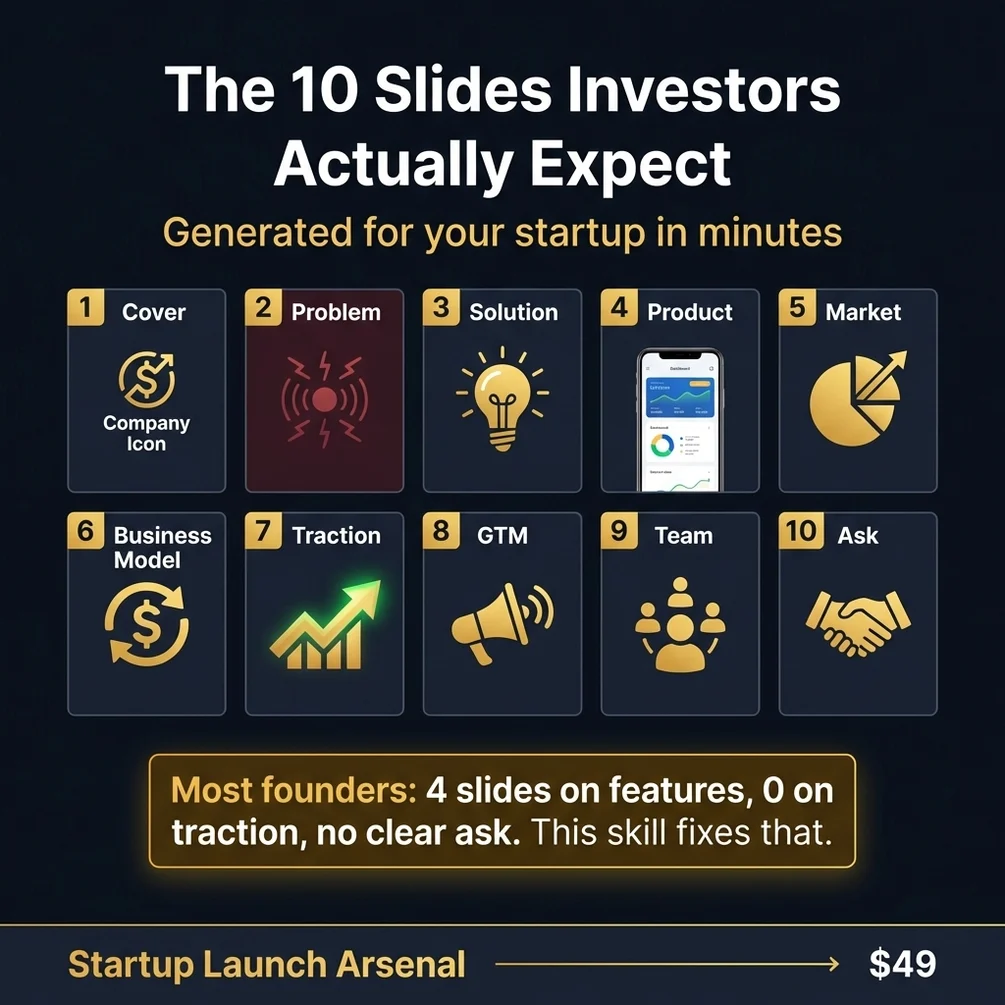
The 10-Slide Pitch Deck
What most founders get wrong: 4 slides on features, 0 slides on traction, market size from a random Google search, no clear ask. This structure fixes all of that.
Launch Strategy
The ORB Framework
Most founders launch by posting on Twitter. That's not a strategy. ORB coordinates three channel types across five phases.
Owned
Your email list, product notifications, blog, social accounts. You control these.
Rented
Product Hunt, Hacker News, Reddit, app marketplaces. Their rules, their audience.
Borrowed
Press, influencers, partners, investor networks. Someone else's audience, activated for you.
Build waitlist (target 1,000+ names), seed Product Hunt hunter relationships, write launch content in advance, brief friendly journalists.
6am ET: Product Hunt submit. 7am: Email waitlist. 8am: LinkedIn + Twitter. 9am: Communities. All day: Respond to every comment.
Convert trial users, fix what broke, collect testimonials, thank everyone who helped.
Content marketing, partnership outreach, write the 'lessons learned' post that earns press.
Document what worked and what didn't. Prep for next launch cycle with real data.
Pricing Strategy
Not Guessing. Methodology.
Most founders price by looking at competitors and picking something similar. That's not strategy. The pricing-strategy skill uses four proven frameworks.
Value Metric Selection
What should scale with price? Users, usage, revenue, or features? Getting this wrong makes every tier wrong.
3-Tier Structure
Almost always the right number. Good/Better/Best with clear upgrade triggers at each tier.
Freemium vs Free Trial
Decision framework based on activation complexity, network effects, and your market position.
Van Westendorp Analysis
Price sensitivity model that finds your optimal range by asking customers four specific price questions.
Who This Kit Is For
Pre-Seed & Seed Founders
Need investor-grade materials that don't embarrass you in the room.
Solo Founders
Need a system for going to market, not scattered blog advice.
YC / Techstars Applicants
Accelerator-specific application module built into investor-materials.
Technical Founders
Can build anything, but have never had to sell anything.
Frequently Asked Questions
What is the Startup Launch Arsenal?
The Startup Launch Arsenal is a collection of 10 Claude Code skills designed for founders going from product-ready to funded and launched. It covers every document and strategy a startup needs: investor pitch decks (10-12 slide VC structure), cold outreach sequences to VCs and angels, market research and TAM/SAM/SOM sizing, 3-tier pricing with Van Westendorp methodology, 5-phase ORB launch framework, 60+ item launch checklist, sales deck, one-pager, demo script, and outbound email sequences.
What does the product-marketing-context skill do?
The product-marketing-context skill creates a positioning document that acts as the single source of truth for your startup. Every other skill reads this document automatically. When you run /investor-materials, it already knows your problem, solution, market, traction, and ask. When you run /launch-strategy, it knows your channels and audience. You build it once; everything else stays consistent.
What pitch deck structure does the investor-materials skill produce?
The skill produces a 10-12 slide deck in the structure investors are trained to read: Cover (company + tagline), Problem (one slide, not three), Solution (approach, not features), Product (demo screenshot), Market Size (TAM/SAM/SOM with credible sources), Business Model (how you make money), Traction (best metric front and center), Go-to-Market (customer acquisition), Team (why you will win), and Ask (how much, what for, timeline). It also generates a one-pager, investor memo, and accelerator application.
What is the ORB launch framework?
ORB stands for Owned, Rented, and Borrowed channels. Owned channels are your email list, product notifications, and blog — you control them. Rented channels are Product Hunt, Hacker News, Reddit, and app marketplaces — you play by their rules but access their audience. Borrowed channels are press, influencers, partners, and investors' networks — someone else's audience activated for your launch. The launch-strategy skill coordinates all three across a 5-phase execution plan.
How does the pricing-strategy skill work?
The pricing-strategy skill uses four methodologies: Value Metric Selection (what should scale with price — users, usage, revenue, or features?), 3-Tier Structure (Good/Better/Best with clear upgrade triggers), Freemium vs Free Trial decision framework (based on activation complexity and market position), and Van Westendorp Price Sensitivity Analysis (finds the optimal price range before you commit). It outputs a complete pricing recommendation, not just a number.
What does the 4-week timeline look like?
Week 1: Run /product-marketing-context to build your foundation, then /market-research for competitive landscape and TAM sizing. Week 2: Generate your pitch deck with /investor-materials and pricing strategy with /pricing-strategy. Week 3: Build your outreach pipeline with /investor-outreach and cold email sequences. Week 4: Generate your launch plan with /launch-strategy and validate readiness with /launch-checklist. Four weeks from product-ready to investor-ready and launch-ready.
Is this useful for non-technical founders?
Yes. The skills are designed specifically for founders who can sell and operate but may not have deep expertise in investor relations, pricing theory, or launch execution. You don't need coding skills. You need Claude Code and a willingness to answer questions about your startup — the skills handle the methodology, structure, and output.
Can I use this for YC or Techstars applications?
Yes. The investor-materials skill includes an accelerator application module specifically for Y Combinator, Techstars, and similar programs. It understands what accelerators look for — coachability, market size, team composition, growth rate — and structures your application accordingly.
How is this different from using ChatGPT to write a pitch deck?
ChatGPT doesn't know your startup, doesn't know what investors look for, doesn't have a pricing methodology, and doesn't know the ORB launch framework. The product-marketing-context skill creates a foundation document that all other skills read automatically — your startup's DNA is baked into every output. The skills also follow proven investor-expected structures, not generic templates.
What stage of startup is this best suited for?
The toolkit is designed for pre-seed and seed stage founders who are product-ready and preparing to raise their first round or execute their first major launch. It is also useful for solo founders going to market for the first time, YC/Techstars applicants, and product managers planning a major product launch within an existing company.
One-Time Purchase
From Product-Ready to Funded & Launched for $39
10 Claude Code skills. Pitch deck, investor outreach, pricing strategy, ORB launch framework, 60-item checklist. Lifetime access, free updates, no subscriptions.
Get Instant Access — $39Secure checkout via Gumroad · Instant digital delivery